Nurturing Attention, Memory and Confidence Among Children in Tanga
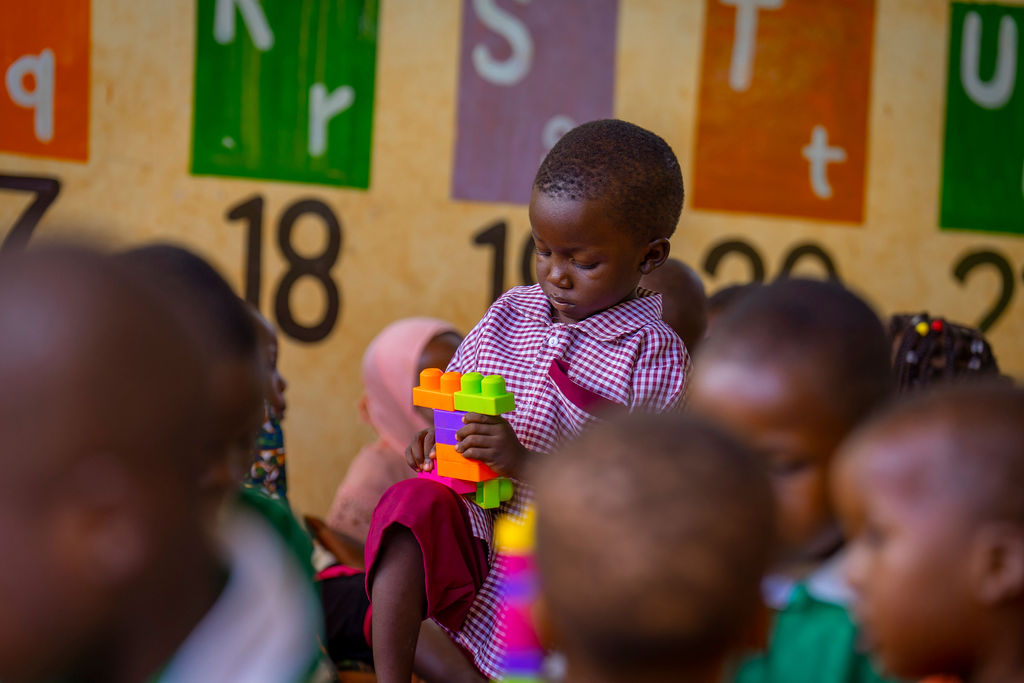


Sixteen kilometres from Tanga Town, beyond the limestone caves of Amboni and along a stretch of road that narrows into Konazedi village, four-year-old Aisha begins her day.
To reach Konazedi, one must drive past Amboni, leaving behind the busier rhythms of town. The roadside shops thin out. The traffic eases, the landscape opens. It is here, far from the commercial centre where private nurseries are commonly found, that Konazedi Community Daycare stands.
Early Childhood Development (ECD) centres are typically associated with town neighbourhoods, closer to offices and formal workplaces. Konazedi challenges that assumption.
At eight o'clock sharp, Aisha slips off her sandals and joins her classmates in a chalk circle drawn on the classroom floor.
“Start, come inside, wait… inside, outside,” caregiver Madam Vick Mgonja calls out.
Aisha leans forward, concentrating. The instructions shift quickly. She pauses, listens again, then jumps to the correct side. A classmate steps the wrong way and laughs.
“This game helps a child to become attentive and listen carefully to what the teacher is directing,” Madam Vick explains.
It looks like an ordinary play. But in that circle, children are strengthening attention, impulse control and working memory. They are training their brains to listen, process and respond. In the early years, such skills shape everything that follows.
Before structured stimulation
In Konazedi and similar peri-urban communities, early childhood has often unfolded without structured learning. Many children spent their mornings at home or outside while parents managed household responsibilities.
Catherine Donato, a parent in the community, remembers how difficult it was before her son enrolled.
“Before my child attended here, there were many groups outside in the streets. He used to roam around,” she says. Keeping constant watch was exhausting. “It was difficult to keep watching him all the time,” she adds.
The effects were not dramatic but noticeable. Some children could recite numbers yet struggled to apply them. Others had limited vocabulary or short attention spans. When they entered primary school, teachers often found uneven levels of readiness.
Dr Samwel Mtullu, Project Manager at United Health for Tanzania Children (UHTC), TangaYetu Implementing Partner, says those early years are critical.
“In early childhood development, we focus mainly on cognitive development,” he explains.
He points to research showing how rapidly the brain develops in the first years of life. “It increases by 50 percent by 18 months and continues to grow significantly up to six years,” he says.
During that period, stimulation shapes neural connections responsible for memory, language, attention and reasoning. Without it, children risk beginning formal education already behind.
The Transforming Early Childhood Development in Tanga City through the Community-Based Solutions Project under the TangaYetu Programme was designed to address precisely that gap. Across Tanga City, nine community daycare centres and nine pre-primary centres now operate in eight wards, serving 260 registered children this year (2026).
Konazedi's centre stands as proof that early learning need not be confined to town.
Learning through purposeful play
After the circle game, Aisha moves to a wall chart where numbers are paired with images.
“When a child comes to the wall chart, they say, ‘This is number one and here there is an elephant,’” Madam Vick explains.
Aisha traces the number and names both the digit and the animal. She is not simply memorising. She is linking symbols with meaning, strengthening memory and expanding vocabulary.
Moments later, the teacher shifts to animal identification.
“Child, can you roar like a lion?” Madam Vick asks.
Aisha laughs and roars. The class discusses where different animals live. A zebra lives in the forest. A rabbit may be kept at home. Through such exchanges, children practise classification, recall and verbal reasoning.
In another activity, caregiver Diana Sekinyashi supervises block-building.
“We provide materials for them to build. One builds a house, another builds a car,” she says.
Aisha stacks blocks carefully. When the structure collapses, she pauses, studies it and tries again. This is problem-solving in action. She tests, adjusts and learns from the outcome.
Teachers track individual progress closely. “When we give assignments and later mark them, we go through each child one by one. That way we understand each child's level of understanding,” Diana explains.
The focus is not on rushing children forward but on ensuring comprehension at each stage.
Changes seen at home
Parents say the impact is visible beyond the classroom walls.
“When my son returns home, he starts telling me, ‘Mama, today we studied one, two, three,’” Catherine says.
She has noticed steady improvement. “His understanding has increased compared to before,” she adds.
Khadija Ibrahim Masimba shares a similar experience. “He did not know how to count before. Now he knows how to count,” she says. She also observes progress in language. “He can speak English and he can write,” she explains.
These changes reflect growth across cognitive domains. Children recall lessons, expanding memory. They use new vocabulary, strengthening language. They reason through games and building activities, sharpening problem-solving skills.
Some mornings, Catherine says, her child insists, “Mama, take me to school.” That eagerness reflects curiosity and confidence, qualities that cannot be measured easily but matter deeply.
A quiet shift beyond town
The presence of a structured ECD centre in Konazedi, 16 kilometres from Tanga Town and past Amboni's well-known landmarks, signals a shift in how early learning is understood. It suggests that cognitive development should not depend on proximity to town or private means.
For Dr Mtullu, the investment carries both immediate and future implications. “We have results now, but we also expect bigger results in the future,” he says.
As the afternoon light filters into the classroom, Aisha sits during story time. “What animal lives in the forest?” the teacher asks. Aisha raises her hand. “Zebra,” she answers clearly.
It is a simple response. Yet within it lies memory, comprehension and the confidence to speak.
In a place where ECD centres once uncommon, young children are learning to listen, to reason and to express themselves.
And in those small, daily moments, the distance from town feels less important than the direction of change.