Choosing Freedom: A Young Girl's Journey from Silence to Strength in Tanga City


On a warm afternoon in Tanga, Eliza (a fictitious name) sits at a wooden table, flipping through a notebook filled with careful handwriting. The house around her feels settled and alive. She moves between rooms comfortably, helping with small chores, greeting others, occasionally laughing with the younger children.
“I do not feel inferior at all,” she says. “I feel like that mother is the one who gave birth to me. I live well with her.”
It is a quiet but powerful statement. There was a time when Eliza avoided conversation, when even smiling felt impossible. Today, she speaks about her future with conviction. “I just want to become a great chef. I want to own big hotels,” she says.
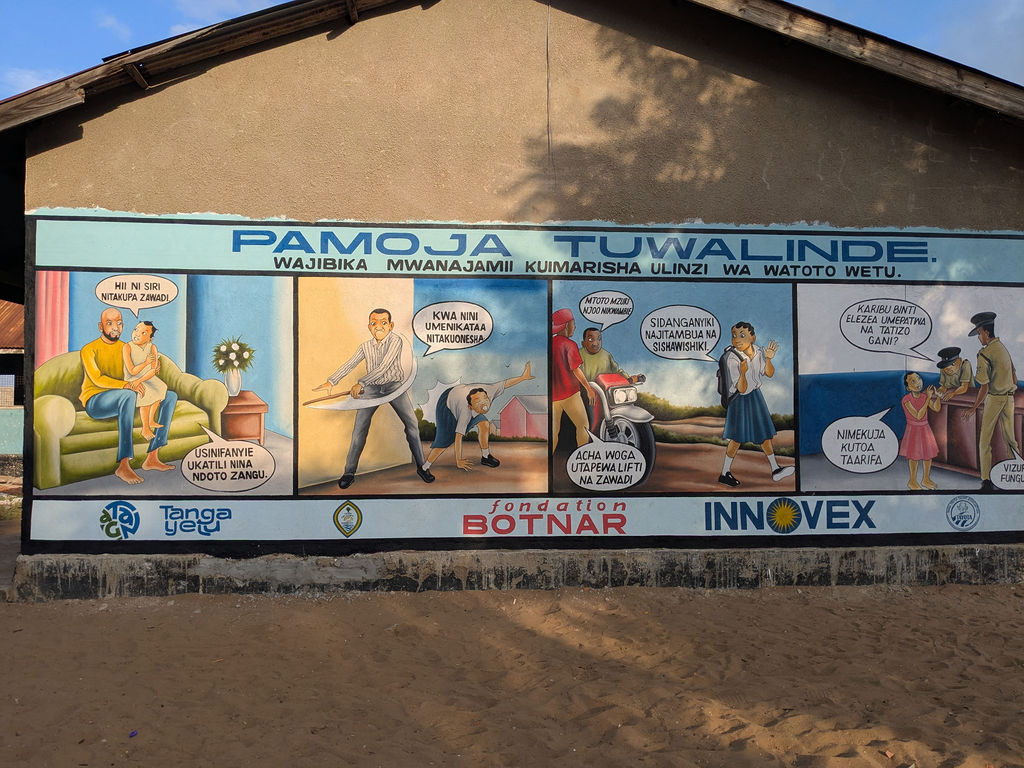
Her transformation did not happen overnight. It unfolded through a structured intervention under the Pamoja Tuwalinde Project, part of the TangaYetu Programme and implemented by TAYOTA. The project strengthens prevention and response mechanisms for Violence Against Children and Adolescents in Tanga city through research, capacity building, coordination and community engagement.
A childhood interrupted
Eliza once loved school. “I really liked studying,” she recalls. Her favourite subject was Kiswahili. But home responsibilities consumed her time. Her mother sold fried fish, and after school Eliza washed dishes, cooked and cared for younger children. There was little time left for homework.
More troubling were the violations that began when she was in Standard Five. “His behaviour was mostly to abuse me,” she says. The man she had grown up calling father was not her biological parent, but he had raised her from a young age.
She tried to speak up. “Many times,” she says when asked how often she reported what was happening. But the situation did not change. Over time, she began spending less time at home, searching for safety elsewhere.
Eventually, she ran away and reported the matter to a local street chairperson, who connected her to other community leaders. That report reached George Bwire, Executive Director of TAYOTA and a lead implementer of the Pamoja Tuwalinde Project.
How the system responded
“We received information about this case from the chairperson of Mgwisha,” Bwire explains.
The project had already established a network of trained community whistleblowers across wards in Tanga. “What we did was build their capacity and identify one person in each ward whose main role is to provide us with confidential internal information,” Bwire says. These individuals include local leaders, youth representatives and ordinary citizens who understand that silence allows abuse to continue.
Because that system was in place, the response was swift. Social welfare officers and police were contacted immediately. “When such incidents occur, we work with the police because they are the ones with authority to make arrests,” Bwire explains.
Through Pamoja Tuwalinde, police officers, magistrates, health workers and journalists had already received capacity-building support to handle cases of violence against children with professionalism and sensitivity. This coordination ensured that Eliza's case did not stall at the reporting stage.
While formal procedures were underway, and with approval from social welfare authorities, Bwire temporarily took Eliza into his own home to provide immediate safety.
Psychosocial and legal support
Rescue was only the beginning. Healing required time and specialised care.
“After the medical examination, the child cried a lot,” Bwire recalls. The emotional weight she carried was visible. A trained counsellor began walking closely with her, offering psychosocial support. A religious leader from her faith community also provided spiritual guidance.
“In the beginning, she could not even smile,” Bwire says. She barely spoke, avoided others and preferred isolation.
Gradually, change became visible. “Now she is very lively. She talks and lives well with other children,” Bwire says.
When asked how she felt upon meeting the team that helped her, Eliza says simply, “I felt good. He has taken care of me well since I left there.”
Legal action followed established procedures. When her parents reported her missing at the police station, coordination allowed her to identify the accused. “She was able to identify him as her father,” Bwire recounts. The suspect was placed under arrest, and the case moved into the justice system.
Rebuilding confidence and purpose
Protection also meant restoring opportunity. Eliza had failed her Standard Seven exams and initially felt detached from school. Yet she still had aspirations.
“I prefer to study cooking,” she says.
Through the Psychosocial Support fund supported by TangaYetu, resources were allocated for her vocational training. She enrolled at VETA to pursue catering studies.
Her confidence today is striking. She speaks about independence clearly. “Maybe I can visit my mother, but I will not sleep there. I want to live freely on my own,” she says.
She also carries a desire to give back. “I will help them too, just as I was helped,” she says, referring to other children experiencing abuse.
A broader community shift
Eliza's story reflects the importance of systems, not just individual rescue. Bwire acknowledges the challenges. “You find that parents sometimes try to persuade the child not to speak,” he says. Social pressure, delayed arrests and geographic barriers can complicate justice.
Yet Pamoja Tuwalinde continues to strengthen coordination across sectors. The project works closely with social welfare officers, whose legal mandate ensures children are interviewed safely and placed in appropriate care during court proceedings. It invests in awareness campaigns so that families understand their responsibility.
Eliza herself offers a simple solution: “Parents should listen to their children when they speak.”
A future reclaimed
In the kitchen, Eliza stirs a pot thoughtfully. She laughs easily now. She engages with others. She imagines a life defined not by harm, but by skill and independence.
Her journey reflects what the Pamoja Tuwalinde Project aims to achieve: prevention where possible, swift intervention where necessary, coordinated legal and psychosocial support, and long-term reintegration grounded in dignity.
Eliza is not a symbol of tragedy. She is a young person rebuilding her life with courage.
In Tanga, that is what protection looks like when systems work together and a community chooses to act.